

3 DOF Hydraulic Extractor Mini JCB Project
Introduction
Hydraulic extractors are fundamental in construction and mining industries, where heavy lifting and precision are paramount. The 3 DOF (Degrees of Freedom) Hydraulic Extractor Mini JCB is a compact powerhouse, designed to perform a variety of tasks efficiently. This article explores the hydraulic mechanism, applications, and benefits of this mini JCB model.
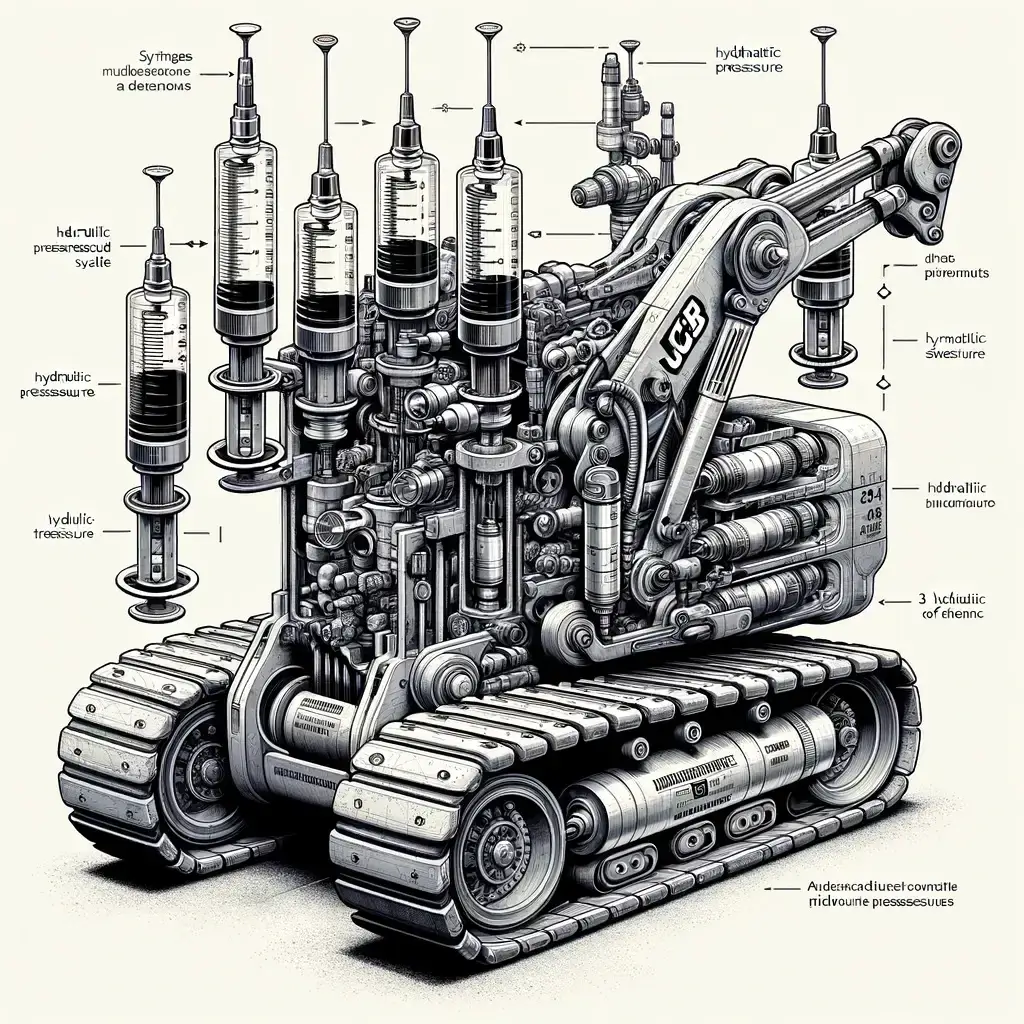
Understanding the Hydraulic JCB Mechanism
The 3 DOF Hydraulic Extractor Mini JCB operates on a hydraulic piston mechanism. Using syringes filled with liquid, it simulates hydraulic pressure that is essential for the movement and operation of the excavator. The three syringes control the excavator’s bucket, vertical motion, and base movement, providing a comprehensive range of motion and control.
Key Features
- Three Degrees of Freedom: Allows for versatile movement and operation.
- Hydraulic Piston Mechanism: Employs syringes as hydraulic pistons for smooth and powerful operation.
- Compact Design: Despite its power, the mini JCB is designed for ease of use and maneuverability in various environments.
Applications
- Construction Industry: Ideal for digging, lifting, and moving materials at construction sites.
- Mining Industry: Capable of handling tough tasks in mining operations.
- Educational Purposes: Serves as a model to understand hydraulic systems and mechanical engineering principles.
Advantages of the Mini JCB
- Efficiency: Performs heavy-duty tasks with precision and speed.
- Adaptability: Capable of working in rough environments and moving in multiple directions.
- Educational Value: Offers insights into the working of hydraulic systems and mechanical design.

What is this hydraulic JCB project?
This hydraulic JCB project — often searched as a JCB project or hydraulic excavator project — is a scaled-down 3 DOF mini JCB that uses syringe-based JCB hydraulic systems to control the arm, bucket, and base. It is one of the most common school and college hydraulic JCB model builds.
How does the JCB mechanism work?
Each syringe acts as a small hydraulic cylinder. Pushing one syringe transfers fluid through the tube to the paired syringe, which extends and moves the linked joint — the same working principle as a real excavator. A hydraulic JCB project explanation usually walks through these three master-slave syringe pairs, and a simple JCB drawing helps visualise which joint each syringe controls.
What are the advantages of this hydraulic JCB working model?
Key hydraulic JCB advantages in this build: no motor required, silent operation, clear visualisation of hydraulic force transfer, and very low cost. The hydraulic JCB working principle can be demonstrated live, which makes the mini JCB a strong classroom exhibit and a solid learning tool for mechanical students.
Where can I get the hydraulic JCB project PDF and PPT?
The complete hydraulic JCB project PDF and hydraulic JCB project PPT — including the JCB drawing, materials list, and step-by-step assembly — are available via the Download PDF button above.
Is a hydraulic JCB working principle PDF or Hindi version available?
The main downloads are in English, but the diagrams and step numbering translate directly. A hydraulic jcb project explanation in hindi can be produced quickly by reading the labelled JCB drawing alongside the hydraulic jcb working principle pdf provided via the Download PDF button. To locate more related builds on the site, a quick site:hscprojects.com search for "hydraulic jcb" surfaces every associated post.
Conclusion
The 3 DOF Hydraulic Extractor Mini JCB stands as a testament to engineering excellence, offering a blend of strength, precision, and versatility. It’s an invaluable asset in heavy-duty industries, and also serves as an educational tool for those interested in mechanics and hydraulics.